From sunrise prayers and laughing yoga to ancient forts and Bollywood dancing, there are moments of pure delight amid the chaos, colour and mischievous monkeys of Rajasthan.
The sizzle of street food, blaring of horns and clamour of voices surround me as I sidestep stray dogs, dodge oncoming rickshaws and gawk at shopfronts displaying everything from gold bangles and saris to sweet treats and dried chillies – the air is alive with spice, smoke and heat. Old Delhi is an assault on the senses in the most fascinating of ways, and far from relaxing.
In a crowded laneway beneath a tangle of overhead wires, a hand reaches out and tugs at my pant leg. I look down to see a woman sitting on the dusty path with a baby in her lap. Her eyes beseeching, she gestures to her mouth in a sign for eating. It’s hard to walk on. Round a corner and there’s an elderly cobbler sitting on a wooden box, asleep. He’s been working in this same spot every day for the past 70 years. When he wakes up and sees us, he grins.
Her eyes beseeching, she gestures to her mouth in a sign for eating. It’s hard to walk on.
Home to more than 30 million people, Delhi is a city that never stands still. Crossing the road feels like a dance with death as motorbikes, tuk-tuks and rickshaws carrying everything from people to towering loads swerve in and out of makeshift lanes, pausing briefly for pedestrians when they have to.
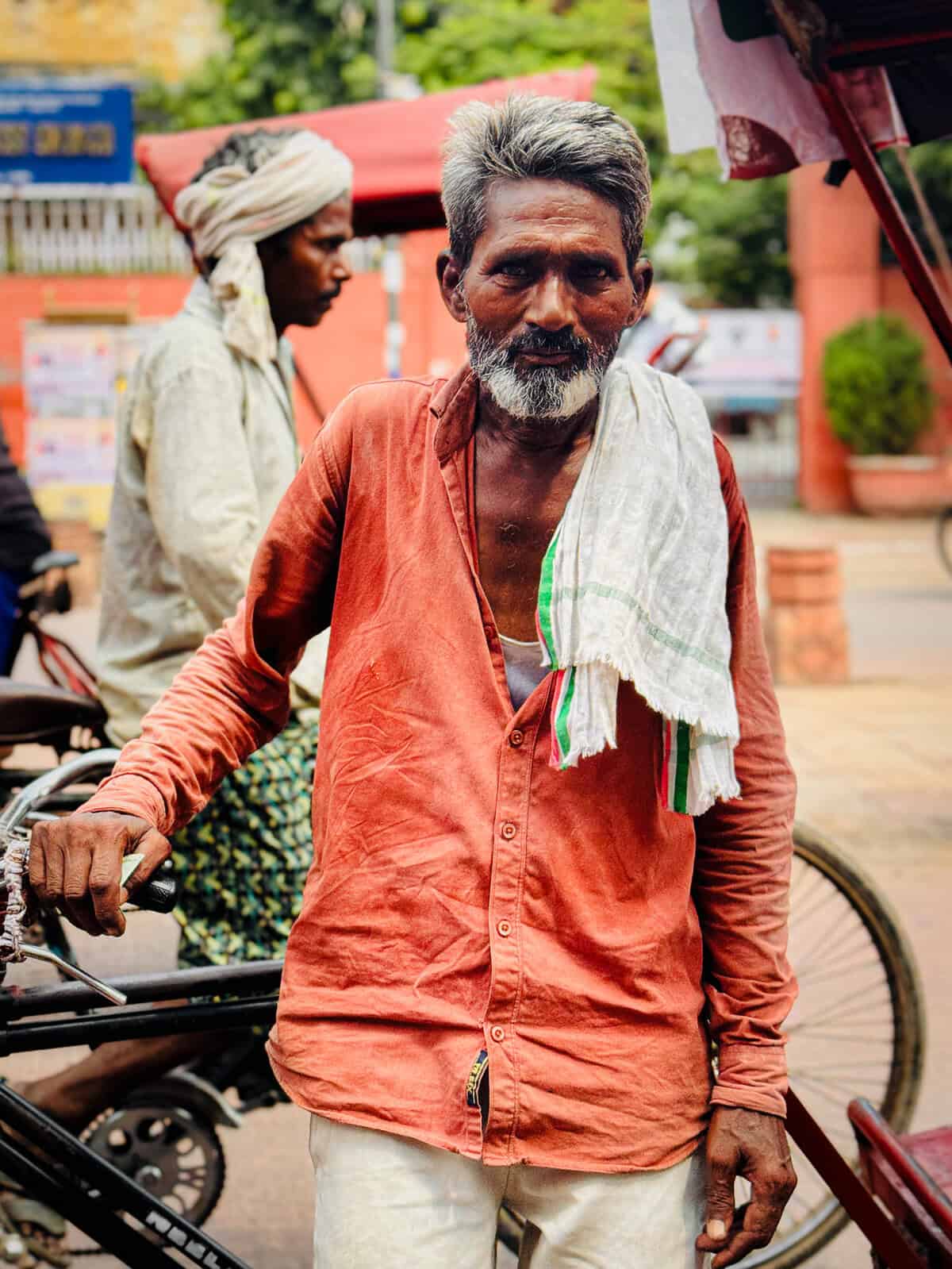
The city has expanded around the walls of Old Delhi, which retains its chaotic charm. Here, a line of roadside rickshaws stands at the ready, some drivers stretching out for a nap while they wait for customers. Traders and smartly dressed businesspeople stride past them or climb aboard, while nearby, a barefoot shoe shiner sitting on the ground scrubs vigorously at a pair of runners with a brush. Standing alongside, scrolling on her phone, a young woman waits for her shoes.
Guided by faith
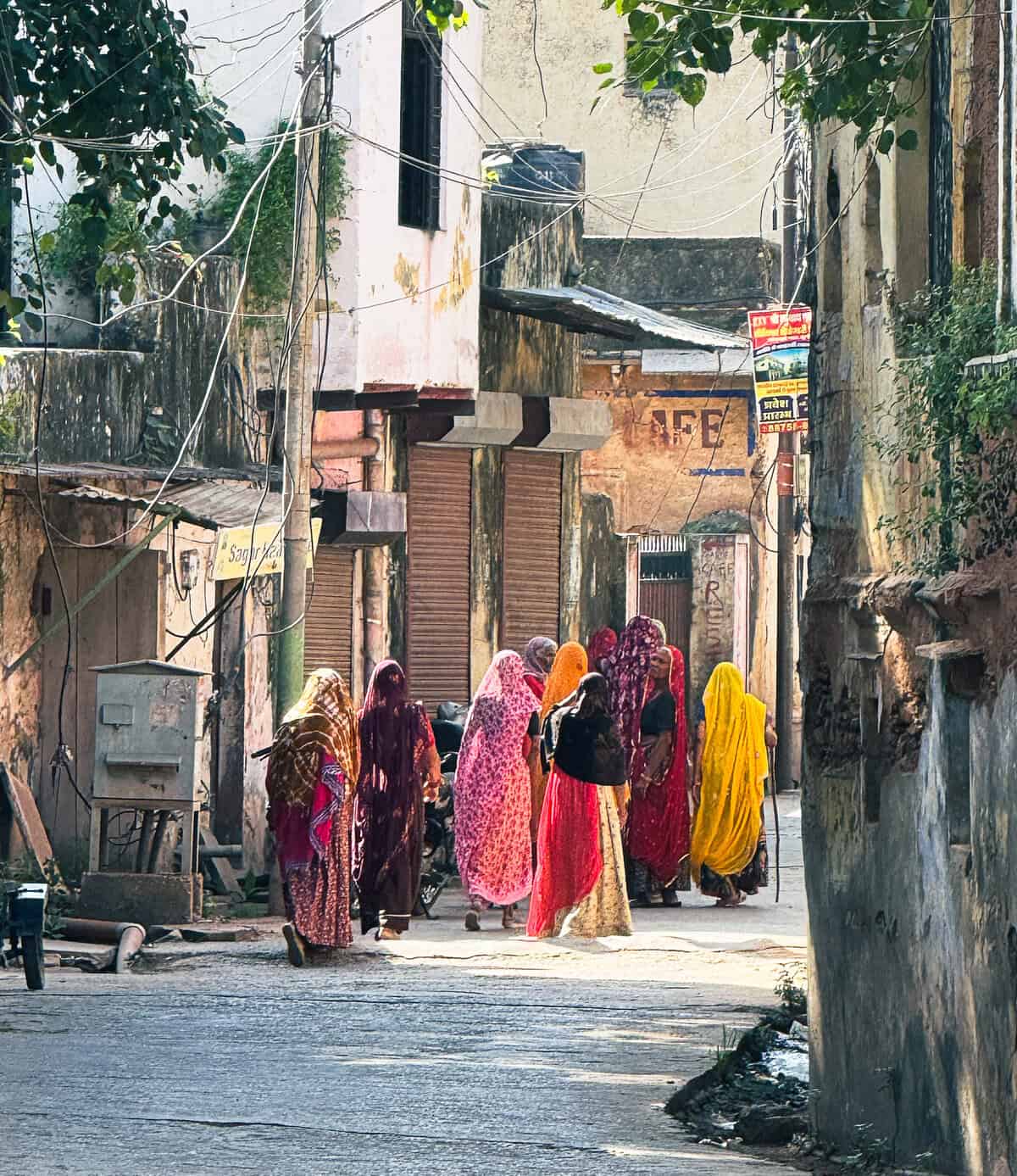
The caste system persists in India, where the social and economic hierarchy determined by birth has been officially abolished but, in reality, still determines career and marriage opportunities. No matter their status in society, taking pride in one’s appearance seems paramount. Men keep their hair neatly trimmed – it’s not uncommon to see haircuts happening on the roadside (and dental work, for that matter) – while women of all ages add vibrant splashes of colour to cities and rural fields alike with their jewel-toned saris.
Most of the country’s 1.6 billion people are Hindu, but karma is a guiding force across faiths here. Visits to Hindu, Buddhist, Jain and Sikh temples are a fitting start to my 12-day G Adventures tour from Delhi through Rajasthan.
Through an open window at the back of a Jain temple, we’re invited to watch a naked monk being served his one meal of the day – food is being placed in his hands. In this Jain tradition, monks give up all worldly possessions, clothing and plates included, and practice non-violence, sweeping the ground they’re about to walk on to avoid harming insects.
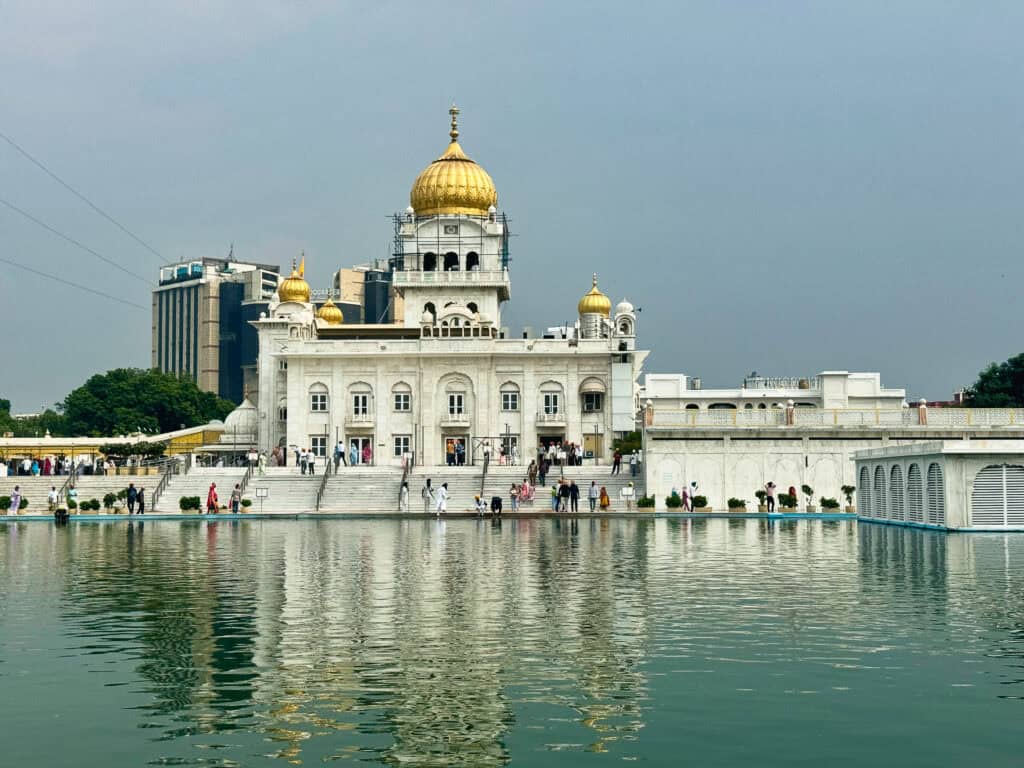
At Sikh temple Gurudwara Bangla Sahib, a sacred Sarovar (pool) attracts pilgrims from far and wide to bathe, rest and reflect. All are welcome here, including us, so we take off our shoes and enter a vast hall where we sit on the marble floor with hundreds of others for a hearty vegetarian meal. Sikhs are known for their kindness and social work, and it’s a moving experience to see their values in action.
The magic of Jaipur
On the way to Jaipur, we stop in at the lovely Anoothi, a social enterprise training marginalised women in scalable skills to make premium hand-crafted goods. We’re greeted with warm smiles and a red tilak pressed to our foreheads – a traditional Indian welcome – and try our hand at block printing. I buy a block-printed, hand-stitched kantha quilt there, a treasure I’ll always cherish.
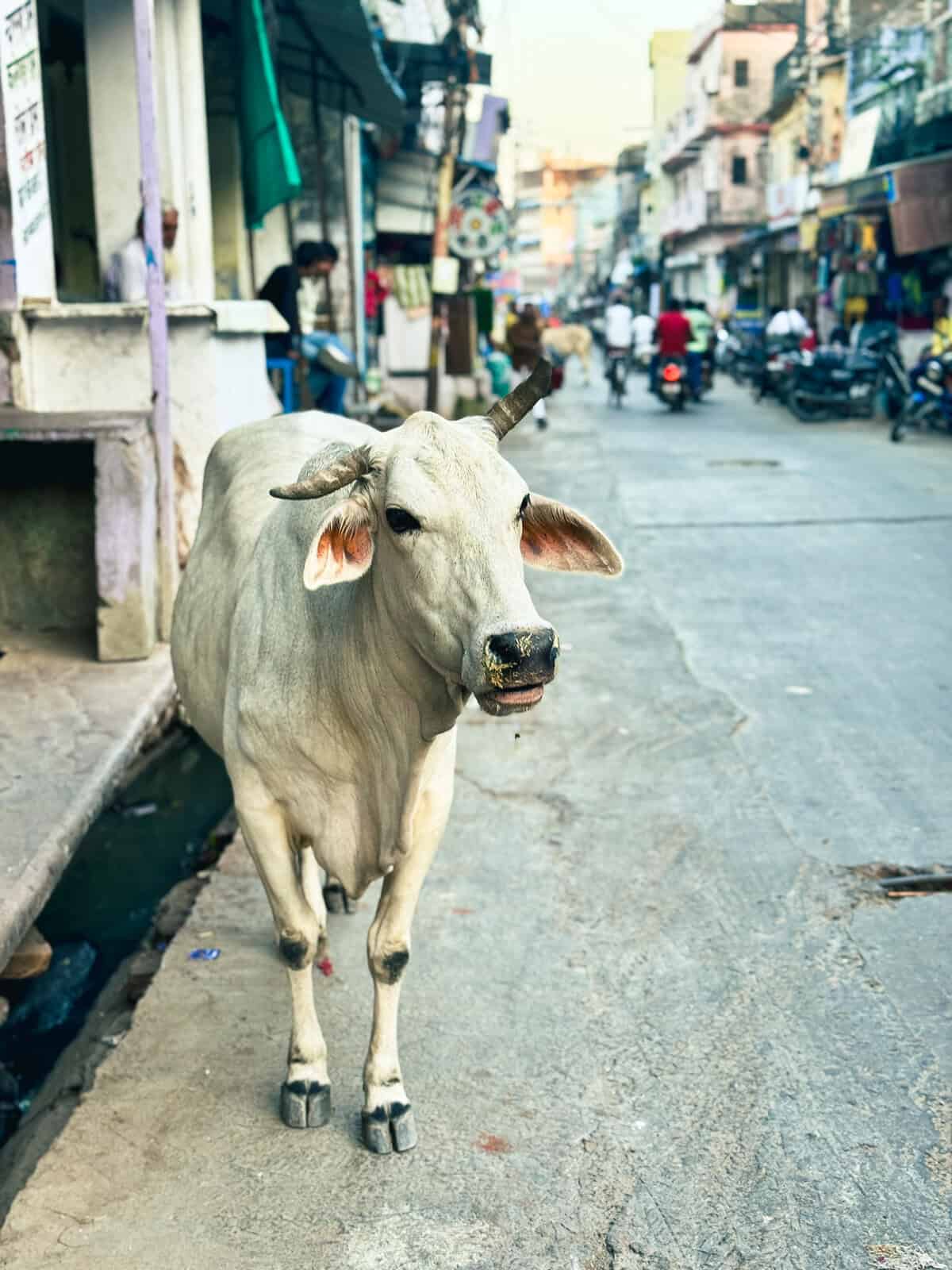
The next day, a 5.30am cycling tour has us peddling through Jaipur as the city wakes up. A sari-clad woman feeds a cow living on the streets and men sip chai before tossing their clay cups into a bucket with a satisfying clink. Nearby, others stir pots of steaming food ready for a day of trading, while monkeys scamper along the awnings overhead.
We park our bikes to make our way through the bustling morning bazaar, where piles of fresh herbs, marigolds (a holy flower used to make garlands for temple), ginger and vegetables of every description are on offer. In the park, we join a laughing yoga session run for locals every morning. We swing our arms, laugh big belly laughs, and follow along as the men perform their morning exercises. It’s uplifting and energising, and I can’t think of a better way to start the day. Next, we join in the chanting at a crowded Hindu temple ceremony, drink our own cups of buffalo-milk chai, and stop by a streetside eatery for spicy samosas. When we arrive back at the hotel, the sun hot in the sky, we’re all on a high.
“I found the temple quite emotional,” says 25-year-old Izzy Lucker, a fellow traveller from the UK. “I thought it was so powerful that so many people had come together and they didn’t look sideways at us coming in and joining them – it was just about joy and worship. It just felt so special to be there.”
Drawn to India
On the G Adventures Solo-ish tour, designed for solo travellers, the 12 of us range in age from 24 to 70 and hail from around the world. Everyone has joined the trip for a reason – some are nursing heartbreak or grief, celebrating a milestone birthday, seeking clarity about their future, or on a quest to explore all seven continents. What we all have in common is a longheld desire to explore India. Doing it this way feels easier, safer and, somehow, meant to be.
Flexibility is woven into the itinerary and all activities are optional, so three of us skip seeing an historic site in favour of visiting some textile shops. Ruby Tabbsum, the miracle-working ‘chief experience officer’ accompanying us, has a trusted tuk-tuk driver pick us up, and he takes us from place to place, deftly navigating the busy streets, before dropping us safely back at the hotel. The cost? About $5.
One of my fellow travellers, from Portugal, asks if we can take a Bollywood dance class so that’s exactly what Ruby arranges for us to do that evening – on a rooftop overlooking the city. With kites dotting the sky against the setting sun, we don bright outfits and, under the guidance of our charismatic choreographer, learn the steps to an energy-filled dance. We perform it to music, sweat glistening and cheeks flushed, for our non-dancing travel companions, their claps fueling the fun.
A rooftop dinner follows – I choose eggplant curry and roti from a vast menu – and we clink cold beers and cocktails in celebration of our good fortune in coming together to discover this incredible place.
Monkey business
We leave the UNESCO-listed pink city’s palaces, forts and people behind the next morning, only to be welcomed by the friendly people of Bundi, a smaller, quieter city. We’re staying in a converted section of a palace built into a forested mountainside inhabited by leopards and tigers. Janardhan ‘Mickey’ Singh bought the derelict property from the former royal family, kicked out the monkeys and converted it into a charming lakeside guesthouse – the Nawal Sagar Palace. A tunnel leads from the palace to the hotel, which the maharaja’s many mistresses used to escape the confines of palace life.
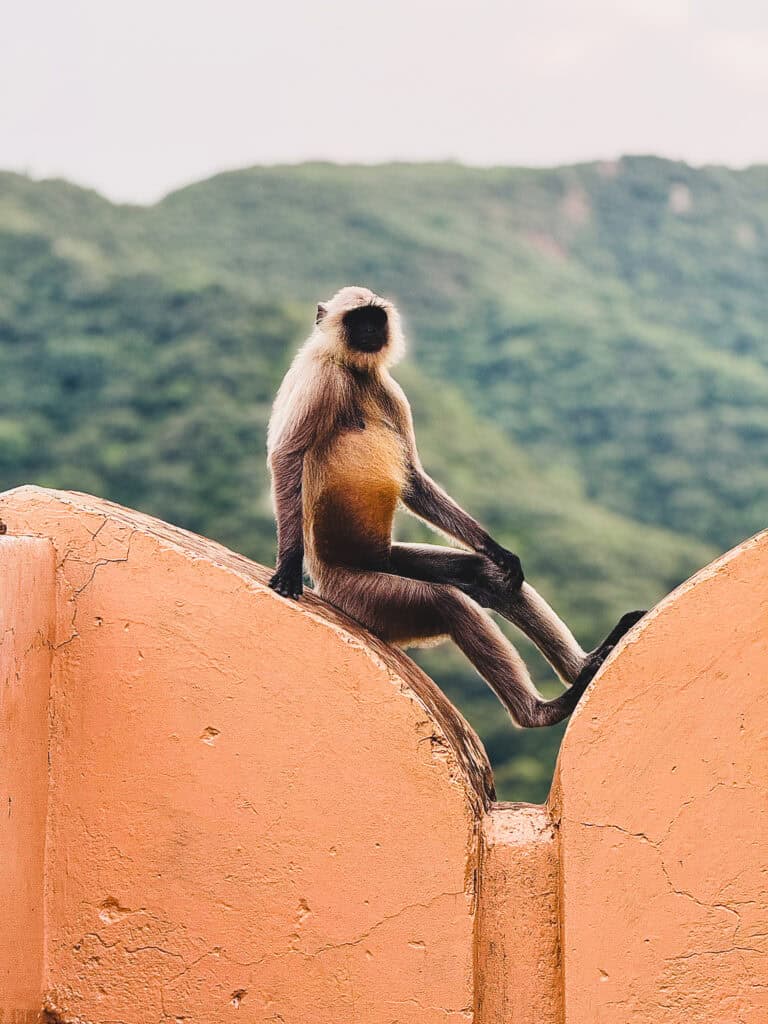
“The monkeys are a big problem,” admits Mickey, when it’s discovered one room’s air-conditioning isn’t working because a monkey has tinkered with it. Like cows and dogs, monkeys are considered sacred, so apart from shooing the mischief-makers away with a big stick or firing a bb gun in their direction, there’s little that can be done.
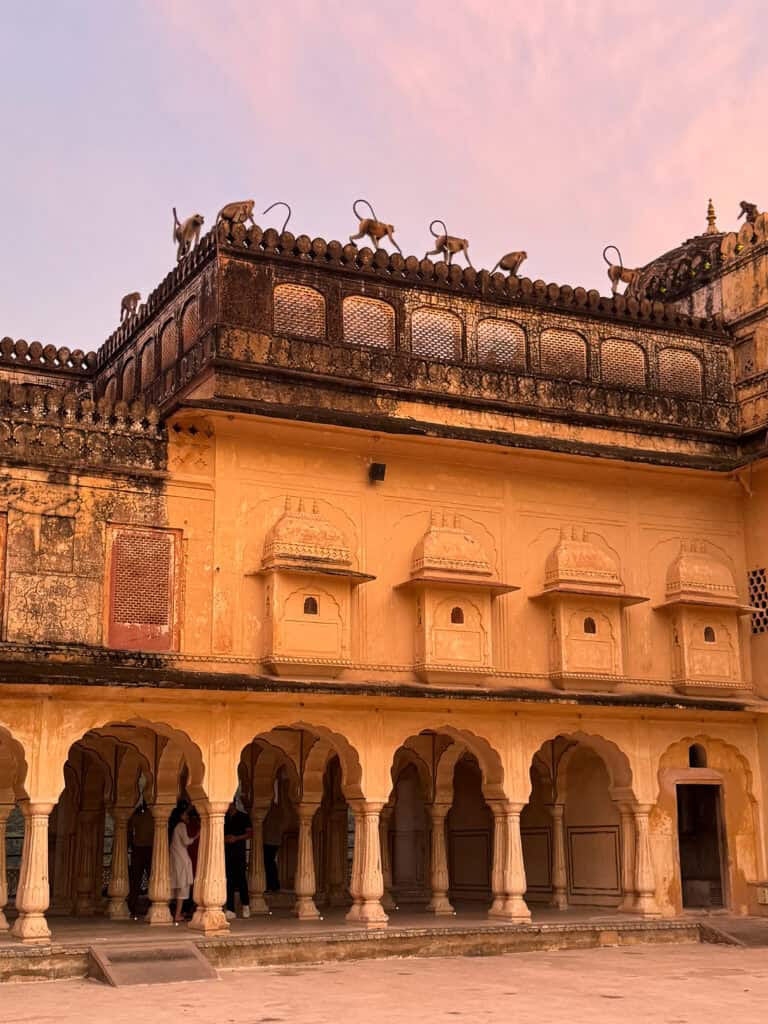
Whole gangs of monkeys live in the forts and palaces of Rajasthan, and when we climb the hill to explore the Garh Palace, built in 1554, monkeys watch our every move. They scamper along ramparts, swim in the pool, swing on overhanging wires and climb through people’s windows to raid fridges and scavenge for food. “Don’t make eye contact or they’ll think you’re challenging them,” warns Jogie, our local guide.
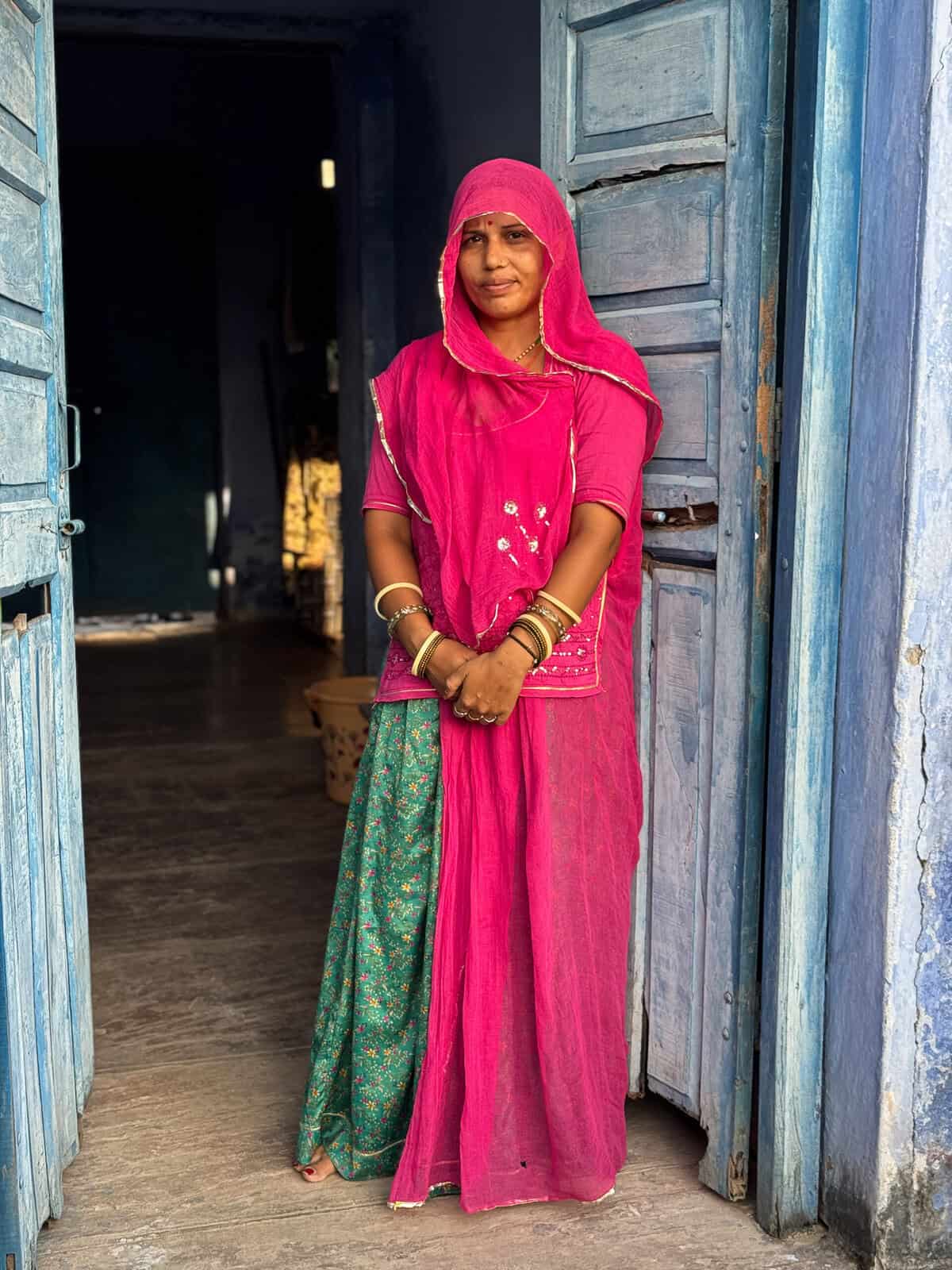
We’re treated like royalty during our stay, dining on delicious local curries and chapatis made with organic produce from Mickey’s farm up the road, cold drinks hitting the spot for sweaty travellers weary but uplifted from another day in, not quite paradise, but exhilarating nonetheless. A visit to the village of Thikardha, 10km from Bundi’s grimy streets, reveals just what a hidden gem we’ve been taken to. Village kids wave and shake our hands, asking ‘What is your name?’, while women greet us with “Ram Ram” and invite us inside their humble homes. They’re as fascinated by us as we are by them.
A grand finale
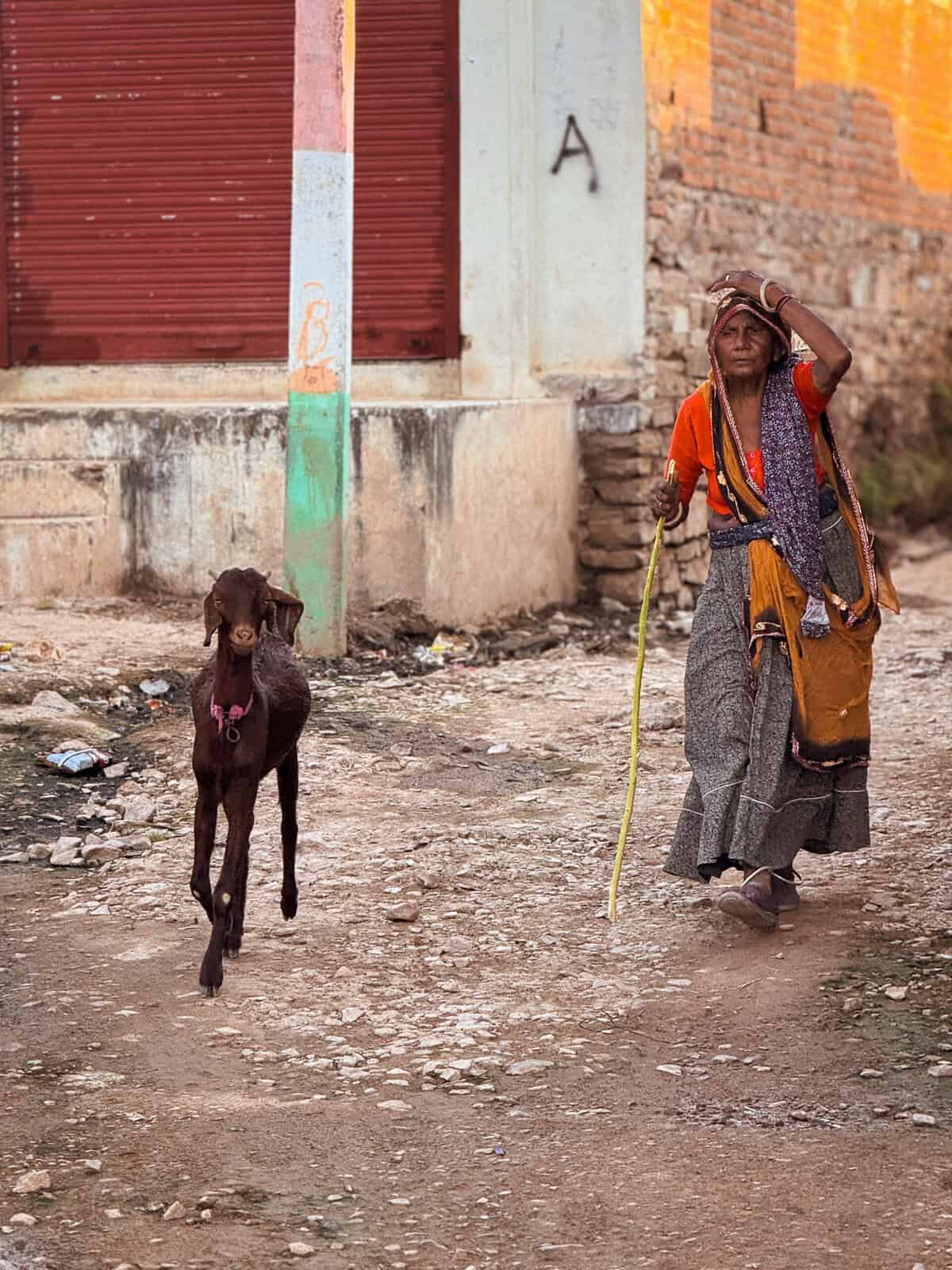
In India, 70 per cent of the population lives in rural villages, and we pass some of the land they farm on our way to Ranthambore National Park. We drive through herds of goats, steer around the odd cow chewing cud in the middle of the road, and marvel at a caravan of camels strolling by. A roadside stall is selling tall green grass beside a dusty cattle yard – it’s good karma to feed the cows, so I happily hand over 30 rupees (50c) for an armful.
Some welcome downtime awaits at peaceful heritage hotel Raj Palace, and many of us take the opportunity to have some clothing made at the on-site tailor – he can whip up a garment of your choosing within hours.
It’s just the time I need to reflect on all we’ve seen and done over the past week. We’ve explored forts and palaces, mastered curry making in a cooking class, gone on safari in search of tigers and leopards, visited majestic stepwells, dined on Indian food everywhere from regal restaurants to simple cafes – I don’t come even close to getting sick of it – and fallen asleep in a blissfully cool cinema playing a movie in Hindu with no subtitles.
Dangling like a carrot at the end of our trip is Agra, where Agra Fort rises grandly from the banks of the Yamuna River and the Taj Mahal beckons through the mist in the distance. The Taj Mahal itself is breathtaking and we’re among the first to enter the gates at sunrise on our last day. The white marble mausoleum was commissioned by Mughal emperor Shah Jahan in the 17th century as a symbol of love for his third wife Mumtaz Mahal. Legend has it that her dying wish was to be memorialised in a place that looked like heaven on earth – it may have taken 20,000 craftsmen 22 years to build it, but I’d say they did pretty well.
This article first appeared in MiNDFOOD magazine.